Fiat Lux
Highlighting impactful collaborations with partners around the globe
The Global Health Program measures our impact through stories of collaboration that celebrate the achievements of our partners. While traditional metrics of academic success are important, on this page, we intentionally seek to "let there be light."
Students help partner in Ghana create first newborn critical congenital heart screening program

At the request of Dr. Nana-Akyaa Yao, Ghana’s only pediatric cardiologist in 2024, two third-year global health Discovery medical students, Abena Adaboh and Daem Celestin, spent five months in Accra assisting Dr. Yao’s team to create and implement the first newborn critical congenital heart screening program in two major delivery hospitals. In one year, over 5,700 babies were screened. The results of this Ghanian led implementation project are in the process of being published in the academic literature with the aim to raise awareness and advocate for more resources to sustain the screening program.
Global Health Collaboration Grant supports radiation therapy training at UCLA for Filipino partners

Through the Global Health Collaboration Award, two medical physicists from the University of the Philippines Philippine General Hospital (UP-PGH), the country’s largest public hospital, completed a four-week training program at UCLA to prepare for the launch of the country’s first stereotactic radiation therapy (SRS/SBRT) program. UCLA Health faculty guided them through treatment planning, patient setup and imaging, and the safety and quality checks required for this advanced technology. Since returning to Manila, they’ve led the rollout of SRS/SBRT at UP-PGH, trained local teams, and built the systems needed to ensure safe and accurate delivery. UCLA’s virtual mentorship has continued, providing ongoing support as they bring this capability online. This work strengthens local cancer care capacity and expands access to high-quality radiation therapy in the Philippines.
UCLA gynecologist and activist from The Gambia speak out to end female genital mutilation
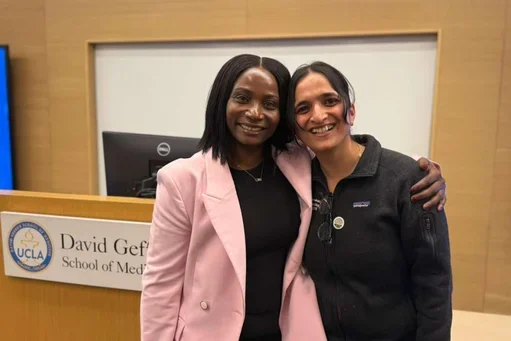
Female genital mutilation (FGM), is defined by the World Health Organization as the "partial or total removal of the external female genitalia, or other injury to the female genital organs for non-medical reasons." FGM has no health benefits, can result in significant obstetrical and other health complications, and is a human rights violation for women and girls. Yet, the practice continues to occur in communities around the globe.
After meeting with Fatou Baldeh, an FGM activist from The Gambia and one of TIME magazine's 2025 women of the year, UCLA Health OB/Gyn, Dr. Aparna Sridhar, authored a statement titled "Ending Female Genital Mutilation: a global call to action from FIGO." This statement condemns FGM on behalf of FIGO (The International Federation of Obstetrics and Gynaecology), and outlines actions that OBGYN member societies and healthcare workers can take.
Read the full story here.