Meeting patients where they are: How Dr. Hijab Zubairi is redefining health equity through community partnership
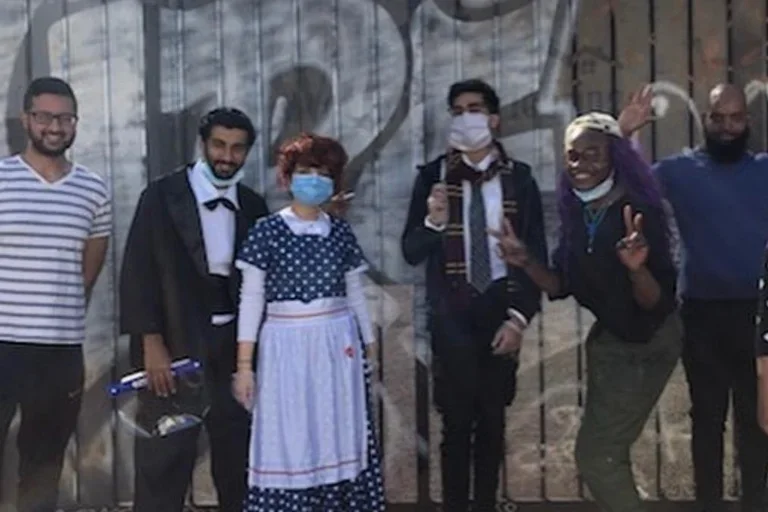
Long before she became a pediatrician and internal medicine physician, Dr. Hijab Zubairi’s understanding of service was shaped far from the clinic, at her local mosque, where her parents volunteered. Her mother cooked, and her father volunteered his accounting services. Growing up, she learned to help wherever she was needed.
“At the time I didn’t realize it,” she reflects, “but these experiences framed how I position myself in the world, as someone whose purpose is to provide service.”
That early foundation did not just inspire a career in medicine; it defined how she would practice it. Today, through Dr. Zubairi’s engagement with the Global Health Program and supporting partnerships with organizations like Esperanza Immigrant Rights Project and The People Concern, she is helping reshape what healthcare can look like when it extends into the community, where she is able to serve those with the highest level of need.
In typical healthcare settings, Dr. Zubairi explains, physicians often see only a narrow slice of their patients’ lives. “Patients come to your clinic or hospital, and you may get a glimpse of their life outside those four walls,” she says. “But for the vast majority, you are missing key elements that are affecting their health.”
For undocumented and unhoused communities, those gaps are even more pronounced. Social determinants of health are not abstract concepts; they are daily realities that shape access, trust, and outcomes. While healthcare systems often rely on patients to share details about their lives and living conditions, Dr. Zubairi believes that seeing the whole picture requires a different kind of engagement with communities.
“In order for healthcare providers to reduce these barriers and improve care,” she says, “we must first learn, engage, and build trust within these spaces. I can say that with each community encounter, I learn something new that I am able to bring back to the healthcare setting and better care for my patients.”
That philosophy guides her work in providing sustenance at food pantries, clinical care in homeless clinics, and in conducting forensic evaluations for asylum seekers, while working with populations where healthcare is inseparable from their daily life conditions. These experiences also shape how she teaches.
For students and trainees, community engagement often challenges long-held assumptions about what it means to be a physician. “As doctors, we are often focused on finding the diagnosis and fixing the problem,” she says. “But many times, the therapeutic intervention is to listen and build a relationship with someone.”
In community settings, the limits of a purely clinical approach become clear. Advising a patient to eat healthy foods, for example, takes on new meaning when you understand what access to food looks like for your patients. “If you’ve volunteered at a food pantry,” Dr. Zubairi explains, “you can better align with the patient and meet them where they are.”
That alignment builds trust in ways that extend beyond a single visit. When physicians are present in the same spaces as their patients, relationships form, and conversations become more open.
The lessons, she emphasizes, are not unidirectional. Working closely with underserved communities has fundamentally changed how she understands healthcare, particularly when it comes to trust.
“I think the biggest lesson I have learned is the large mistrust people have in our healthcare system,” she says.
In Los Angeles, that mistrust is compounded by a complex and often fragmented health system. “Most patients in the ‘safety net’ are anything but safe,” Dr. Zubairi says. “We can’t rely on placing the right referral and moving on.”
Dr. Zubairi sees her role as working alongside patients to navigate barriers and identify solutions together. “Meeting patients where they are,” she explains, “is far more than geography. It includes their priorities, their stressors, their mental health, and their trust, or lack of trust, in the system.”
At a time when healthcare systems face increasing strain, sustaining hope can be difficult. For Dr. Zubiairi, hope comes from the community.
“What keeps me hopeful is working alongside like-minded individuals who face each challenge and band together to find solutions,” she says. “I am always humbled by the generosity and grace individuals have for each other. Those moments have uplifted me when I feel hope is lost.”
Looking ahead, Dr. Zubairi sees promise in the next generation of physicians, who have been successful in advocating for physician wellbeing and rights “in a profession that has become more and more insurance and corporation driven.” She hopes that this same energy will extend to changes within the healthcare system.
“I would love to see this level of advocacy translate into holding insurance companies, hospital systems, and corporations more accountable to the communities they serve,” she says.
Ultimately, Dr. Zubairi envisions a more community-centered model of care, one that reconnects physicians with the people and places they serve, despite the challenges in doing so in a big city like Los Angeles. “It may not look like it did in the past,” she says, “but centering healthcare around communities is the direction we need to move in.”