Mentorship Across Borders: Full Interviews with Dr. Karin Nielsen and Christopher Hernandez
Below are the full interviews conducted by the Global Health Program with Dr. Karin Nielsen and her mentee, Christopher Hernandez.
→ Jump to the student interview with Christopher Hernandez
Interview with Dr. Karin Nielsen
Dr. Karin Nielsen is a Professor of Pediatrics in the Division of Infectious Diseases at UCLA. She is an attending physician for Pediatric Infectious Diseases at Mattel Children's Hospital and co-director of the Care4Families HIV clinic at UCLA. Dr. Nielsen is a physician-scientist, originally from Rio de Janeiro, Brazil. She has a very active collaboration with multiple sites in Brazil both in the field of HIV, congenital infections, and ZIKA virus, with active NIH grant funding for her studies. Dr. Nielsen has mentored many medical students, residents, graduate students and post-doctoral fellows at UCLA and from around the globe.
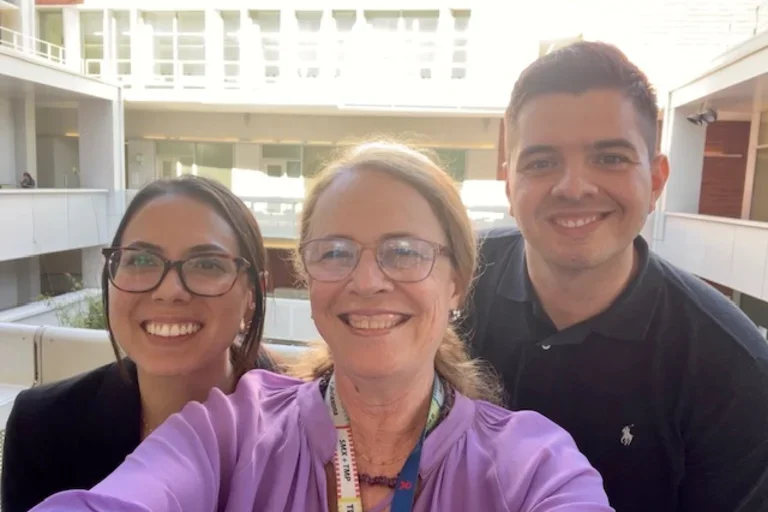
Given her success in mentoring DGSOM trainees over the years, GHP was thrilled to learn more about Dr. Nielsen and her mentoring style, while also learning about a fourth-year medical student that she has been mentoring since his second year of medical school.
GHP: Your research in pediatric infectious diseases has included long-standing collaborations in Brazil. How did this work begin, and why has longitudinal engagement in Brazil been so important to you as a clinician-researcher?
Dr. Nielsen: I was born and raised in Brazil and went to medical school and attended residency in Rio de Janeiro. Throughout my training in Brazil and also working as a young doctor there before coming to the U.S., I saw so many facets of infectious diseases and often wondered how to improve the overall health and lives of people living in disenfranchised conditions.
Once I came to the U.S. for a fellowship in Peds ID, I saw so many opportunities to apply the skills and knowledge gained to improve diagnostics and management of the many infectious disease conditions I witnessed over the years. I wanted to contribute to the improvement of health conditions in my country and give back to a system that taught me so much and provided me with free medical education. It was also fun to study new and old infectious diseases, which had always fascinated me.
GHP: You have mentored many medical students who have pursued infectious diseases research and published during medical school. How did your mentoring relationship with MS4 Chris Hernandez begin, and what initially stood out to you? Over the past four years since you began working together, has anything surprised you?
Dr. Nielsen: I first met Chris when he joined our South American Program in HIV Prevention Research (SAPHIR) at UCLA. Chris had prior training in statistical analysis when he joined our program, so he was ready to jump into the program and analyze data from the start. He was very diligent and unstoppable, but what was interesting was to see his interest in infectious diseases and also his appreciation and fascination with Brazil increase over time.
Once he completed SAPHIR, he did not return to UCLA right away. Instead, he applied to and was funded for a medical student (GERM) scholarship by the Infectious Diseases Society of America, which enabled him to continue doing research in Brazil. He also joined the UCLA Global Health Equity Pathway, and continued working in Porto Alegre, Brazil during the Discovery Year. He ended up staying 19 months total in Porto Alegre and has returned for an additional 3 months during his fourth year of medical school to complete additional HIV studies.
This experience was transformative for him. What stood out most was his ability to see challenging conditions as a learning opportunity. While Chris was there, Porto Alegre experienced the worst floods they had seen in decades. This enabled Chris to work on a fascinating project he helped develop with our team, which evaluated patients for leptospirosis and dengue, finding that contrary to what public health departments predicted, the major problem following floods in Porto Alegre was not leptospirosis, but dengue outbreaks. It was a fascinating collaborative study, which probably helped Chris give up his idea of becoming a psychiatrist and choosing a career in infectious diseases, which is the path he is pursuing. One of the things that surprised me about Chris is his diligence, interest in research, and dedication to the field.
GHP: What is your mentoring philosophy, and what kinds of mentor–mentee relationships tend to work best for you—particularly when working with medical students?
Dr. Nielsen: I firmly believe you learn by doing, so I tend to be very hands on with trainees, helping them come up with research ideas, hypotheses, and the design of their studies. We look at the data, brainstorm how to best address the question at hand, put the tables and figures together, have them write abstracts, present their data, and complete their manuscripts.
As part of many of these training programs, they also write grants, meet with statisticians, and learn to code data. I enjoy the weekly meetings we have and especially love seeing them master all these skills and evolve over time. I particularly enjoy seeing them put their presentations together and present findings at conferences, which makes them feel successful. It has been a very rewarding experience, and I am grateful to have been able to mentor so many uniquely talented students.
GHP: Based on your experience mentoring many DGSOM trainees over the years, which skills, habits, or perspectives do you hope trainees develop through working with you and your partners in Brazil?
Dr. Nielsen: I think it is very important for students to learn diplomacy through their global health experience, develop cultural awareness, and to be sensitive about data sharing and collaborating equally with their local mentors and peers. All the students I have mentored throughout many years in Brazil have been successful in developing excellent rapport with local colleagues.
They are curious and respectful of other cultures and most of them have even learned Portuguese. I am thrilled to hear from my local collaborators how much they appreciate our students and how diligent and dedicated they have been, and how great it is to see their findings published. I believe this quest to learn, to share, and to develop collegial, collaborative relationships is extremely important for a successful research career since successful partnerships are instrumental in driving research forward.
GHP: Thank you so much for speaking with us, Dr. Nielsen!
Interview with Christopher Hernandez
GHP was also able to ask questions of Dr. Nielsen’s mentee, Christopher Hernandez. Chris is a fourth-year medical student at DGSOM who is part of the Global Health Equity Pathway and spent his Discovery Year and more engaging in infectious diseases research in Brazil. He is applying to residency programs in Internal Medicine, while also spending time in Porto Alegre both for research and a clinical experience during his final year of medical school.
GHP: How did you first become connected with your mentor, Dr. Karin Nielsen, and what drew you to her work?
Chris Hernandez: After finishing my ObGyn rotation during my second year of medical school, I initially thought I would pursue a career in maternal-fetal medicine (MFM). I entered medical school with an interest in infectious diseases (ID) more broadly, and MFM felt like a natural intersection between maternal health and ID. As I began preparing for my Discovery Year, I started exploring research opportunities and reaching out to potential mentors.
Dr. Karin Nielsen’s work immediately stood out to me, particularly her research on congenital HIV, syphilis, and arboviral infections. I reached out to her hoping to contribute in any capacity. During our first meeting, she offered me the opportunity to join a project in Porto Alegre, Brazil, focused on congenital HIV transmission. The region has some of the highest rates of HIV in pregnancy and mother-to-child transmission of HIV in Brazil, and Dr. Nielsen had overseen several projects aimed at understanding the dynamics of this epidemic. I was immediately convinced this was the type of work I wanted to do during medical school.
GHP: You’ve been highly productive in infectious diseases research during medical school. Did you know this would become such an important part of your training?
Chris Hernandez: To be honest, I did not know what Brazil would hold for me. I did not speak Portuguese, had no prior ties to the country, and was unsure how I would be most helpful to the team.
Early on, I proposed a project during a team meeting that integrated my interests in HIV, substance use, and barriers to care among pregnant women living with HIV. Dr. Nielsen was incredibly supportive and encouraged me to pursue the project, even though it required building it largely from the ground up. That moment confirmed that I had chosen the right mentor. Throughout my training, she has continued to support my research endeavors, providing guidance when needed while also giving me the independence to grow as a researcher.
GHP: You’ve returned to Brazil multiple times during medical school. What has kept bringing you back, and how has this experience shaped you?
Chris Hernandez: Many factors have drawn me back to Brazil over the years, including the friendships I have formed, the opportunity to continue improving my Portuguese, and the proximity to some of the most beautiful places I have ever visited. From a research perspective, however, the close partnerships I have developed have been the primary motivation to return.
I met several infectious disease residents who invited me to collaborate on projects examining the high rates of AIDS-related mortality in the region. Through these collaborations, we built large databases that describe the populations of those most affected. Some of the data we collected was ultimately used to support increased funding for outpatient clinics and outreach. Seeing research used to drive actual change has been incredibly rewarding and has shaped how I think about the role of academic medicine.
GHP: Many students complete shorter research projects during medical school. What has it been like to build a multi-year research identity with the same mentors?
Chris Hernandez: The most rewarding aspect of long-term mentorship has been the depth of the research questions we’ve been able to ask. One of our flagship projects was a large retrospective study of patients hospitalized on the infectious diseases wards, which required months of data collection and ongoing conversations with local clinicians to ensure we were answering questions that would genuinely serve the community.
Reaching that point required learning how to navigate Brazil’s health data systems, building relationships with collaborators who could guide the work, and, importantly, learning through trial and error. Many of those early mistakes I made would have been difficult, if not impossible, to overcome within a short-term project. Having the time to reassess and improve allowed us to complete a study that simply could not have been started, let alone finished, in just a few months.
Over time, I also came to understand the data through a more nuanced lens. Not only did I read the studies published by local researchers, but I reviewed thousands of medical records, including detailed social worker notes, spoke with clinicians and patients about their experiences, and learned to navigate the medical system firsthand. Together, these experiences allowed me to interpret our findings in a way that better reflects the local realities of South Brazil.
GHP: As you finish your MD degree at DGSOM, what’s next for you—and what advice would you offer to students hoping to make global health research meaningful?
Chris Hernandez: I am currently applying to internal medicine residency programs and plan to continue pursuing a career in infectious diseases. Since I began this path, my world has opened in unexpected ways, and I am excited to see what comes next.
My biggest advice to students interested in global health research is to remain open to opportunities, even when they feel intimidating. If you are curious about a topic and find a way to contribute to the work being done in another country, you never know how meaningful the experience may become. Prior to my time in Brazil, I had never seriously considered global health or how it might fit into my career. Now, I cannot imagine my medical training without it.
GHP: Thank you for sharing a bit about your global health work during medical school, Chris! We are excited to share the work you have published while at DGSOM with our readers, which includes nine publications with Dr. Nielsen that can be found here.
Photo: Dr. Nielsen (center) with her two mentees, fourth-year medical students, Christopher Hernandez and Karen Kikuta