Undergraduate Spotlight on Chloe Alderson: Partnering with Communities in Ghana
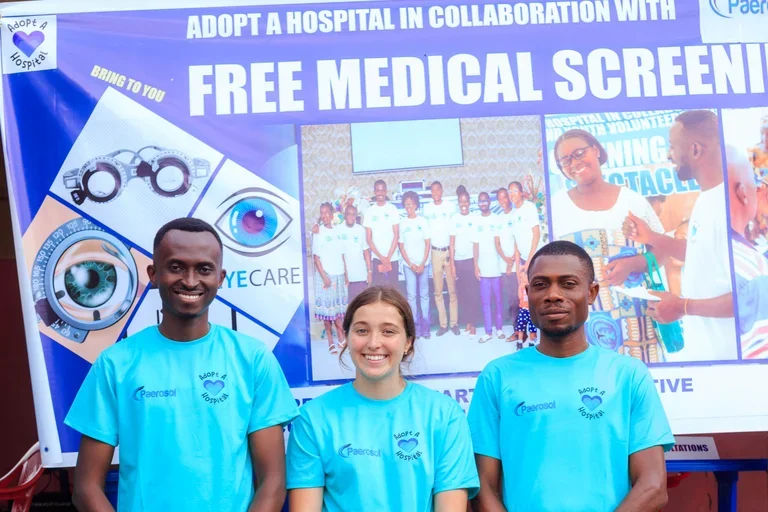
Chloe Alderson is a UCLA junior whose global health work in Ghana began in high school and continued after becoming inspired by a global health course she took as a freshman at UCLA. Majoring in Physiological Science with minors in global health and education studies, Chloe’s research and nonprofit work in Ghana focus on HIV education, reproductive health, and community-based healthcare access, while collaborating very closely with local partners.
In this interview, Chloe reflects on how a UCLA course shaped her research focus, what she has learned about ethical global health partnerships, and how her time in Ghana continues to shape her goals as a future physician.
GHP: What inspired you to devote so much of your undergraduate experience to global health and, specifically, to HIV education work in Ghana?
Chloe: Ever since I went to Ghana as a volunteer in high school, I have been passionate about global health. This passion persisted at UCLA, where I decided to minor in global health. During a prerequisite class, I learned about the prevalence of HIV in Eastern Africa, which prompted me to conduct my own research in Ghana. I discovered a significant gap in reproductive health and HIV/AIDS research in Ghana, which led me to craft a scoping review that informs my current research.
GHP: Can you share a defining moment during your global health work that shaped how you see your role as a researcher or future physician?
Chloe: One of my most impactful experiences was during one of the free clinics I supported last summer in the Swedru Region of Ghana. During this clinic, a team of 20 doctors and volunteers treated over 1000 patients for free. These patients were all seen by doctors or were referred to larger hospitals, as needed. We signed up 200 new patients for free health insurance to support the cost of future hospital visits. I was stationed at the laboratory, where I tested patients' blood for malaria, HIV, and other diseases. One patient stood out to me, as she was young, timid, and alone at the clinic. She ordered an HIV test and was relieved when I gave her the negative result. She immediately cried in my arms, as if a huge weight was lifted from her. She voiced that she felt there was stigma around HIV and a lack of knowledge about the seriousness of the disease. She also emphasized that she had not been able to find a test prior to that day due to a lack of access to health care. This moment truly inspired my research as it highlighted the significant need for improved health education. I was committed to working towards better community health literacy, with the goal of having every patient knowledgeable about their diagnoses and met with care rather than stigma.
GHP: What were some of the biggest challenges you faced in getting involved in global health research so early in your undergraduate, and how did you overcome them?
Chloe: One of my biggest challenges early on was finding a mentor who would support my research project at UCLA. I met with several mentors who either lacked the bandwidth to support my project or did not believe it would be feasible. I am so grateful that I was ultimately connected to Dr. Traci Wells at UCLA, in addition to my Ghanaian mentor, Dr. Ransford Aduah, as I could not have navigated the IRB process in both countries without their support.
Getting the IRB passed in Ghana was more challenging than I thought it would be. I ultimately decided to study abroad last summer at the University of Ghana in Legon, so I was able to submit my proposal in person to the IRB. Additionally, we travelled over 10 hours to submit the approval to the district's Educational Board, where the research would take place, which was another challenging step in the process. I am grateful that I have such amazing Ghanaian mentors who guided me through every step. Because of the mentorship support I received both at UCLA and in Ghana, we anticipate having two additional manuscripts published by the end of this academic year.
GHP: What exciting accomplishments! You also founded Adopt a Hospital prior to coming to UCLA, a nonprofit that aims to support healthcare through hospital supply donations and free clinics, in addition to your research in Ghana. What have these two experiences taught you about ethical global health work?
Chloe: Too often, research is conducted without giving back to the community. I believe it is essential to ensure that our findings and initiatives remain accessible to the populations they impact the most, so I see my research and my work with Adopt A Hospital as completely intertwined. I believe it is essential to understand a community’s unique needs before initiating any project; for example, in Ghana, every province follows its own distinct laws, requiring slightly different project protocols. I have also met with chiefs before entering a community, as it is customary to do so prior to working in a community. Furthermore, in my two research papers, I am serving as co-first author alongside the local lead research investigator Mr. Ebenezer Efichie. This research would not have been possible without Mr. Efichie’s guidance, and I am honored to share authorship with him in this way.
GHP: As you look ahead to graduation, what are your long-term goals in medicine, research, or global health? How do you hope to build on the work you’ve already started?
Chloe: In the coming year, I aim to present our research findings at a global health conference. My post-graduation plans include applying for a Fulbright to continue my research in Ghana, as I have seen the value of longitudinal engagement with the same partners. I am also committed to integrating my nonprofit work into my medical career, with the ultimate goal of returning to Ghana to serve as a physician at an Adopt A Hospital clinic.
GHP: What advice would you give to students who feel passionate about global health but aren’t sure where or how to begin?
Chloe: I think the biggest piece of advice I would give is to get involved early. My first experience in Ghana with Project Sunshine was incredibly meaningful and solidified my passion for global health. Beyond international work, there are so many impactful local projects within Los Angeles and across the United States. I also recommend choosing coursework that aligns with your specific interests. I have truly enjoyed my global health minor at UCLA, as it has allowed me to explore and refine my interests.
GHP: Thank you for sharing your global health work with us, Chloe!
Photo: UCLA Undergrad, Chloe Alderson, with her mentor Dr. Aduah (left) and Mr. Foster (right).