Mentorship Across Borders: A Pediatrics Infectious Diseases Mentor and Her Mentee
Read the full interviews with Dr. Karin Nielsen and Christopher Hernandez →
For Dr. Karin Nielsen, mentorship has always been inseparable from the work itself. A Professor of Pediatrics in the Division of Infectious Diseases at UCLA, Dr. Nielsen is an attending physician at Mattel Children’s Hospital and co-director of the Care4Families HIV clinic. She is also a physician-scientist whose work has spanned decades and continents, most notably through long-standing collaborations in Brazil focused on HIV, congenital infections, and emerging infectious diseases.
Born and trained in Rio de Janeiro, Dr. Nielsen came to the United States for fellowship training with a deep desire to give back to the health system that shaped her. “I saw so many facets of infectious diseases growing up and early in my career,” she reflects. “Once I came to the U.S., I realized how much opportunity there was to apply those skills to improve diagnostics, management, and ultimately people’s lives, particularly in settings with limited resources.”
That philosophy, which includes learning by doing, grounded in long-term partnership, has defined not only her research, but her approach to mentorship. Over the years, Dr. Nielsen has mentored medical students, residents, graduate students, and fellows from UCLA and around the world, many of whom have gone on to publish, present internationally, and build sustained global health careers.
One of those mentees is Christopher Hernandez, a fourth-year medical student at DGSOM whom Dr. Nielsen has mentored since his second year of medical school.
Chris first connected with Dr. Nielsen while exploring research opportunities ahead of his Discovery Year experience in the David Geffen School of Medicine (DGSOM) curriculum. Initially considering a career at the intersection of maternal-fetal medicine and infectious diseases, he was drawn to Dr. Nielsen’s work on congenital HIV, syphilis, and arboviral infections in southern Brazil. “During our first meeting, she offered me the chance to join a project in Porto Alegre focused on congenital HIV transmission,” Chris recalls. “I was immediately convinced this was the type of work I wanted to do during medical school.”
What began as a single research opportunity quickly evolved into a multi-year collaboration. After joining UCLA’s South American Program in HIV Prevention Research (SAPHIR) fellowship program, Chris subsequently received funding from Infectious Diseases Society of America (IDSA) and then joined GHP’s Global Health Equity Pathway for his Discovery Year, which allowed him to remain in Brazil to continue doing research. He ultimately spent more than 19 months in Porto Alegre during medical school, returning during his fourth year to complete additional HIV studies. He will return to Porto Alegre again in April 2026 for a global clinical rotation at PUCRS, one of the bilateral student exchange partners of the Global Health Program.
For Dr. Nielsen, what stood out was not just Chris’s technical ability, but his mindset. “He was very diligent and unstoppable,” she says. “But what impressed me most was his ability to see challenging conditions as learning opportunities.”
That perspective proved critical when historic flooding struck Porto Alegre during Chris’s time there. Public health officials anticipated a surge in leptospirosis cases, but Chris worked with local collaborators to evaluate patients for both leptospirosis and dengue. They ultimately found that dengue, not leptospirosis, posed the greater threat. The project became a powerful example of how careful data analysis, local partnership, and flexibility can challenge assumptions and inform real-world responses.
Dr. Nielsen’s mentoring philosophy is deeply hands-on. She works closely with trainees to develop research questions, analyze data, build figures, write abstracts and manuscripts, and present findings at conferences. “You learn by doing,” she emphasizes. “I love seeing students master these skills over time and gain confidence as they share their work.”
For Chris, that long-term mentorship made it possible to ask deeper, more meaningful research questions. “Some of our flagship projects required months of data collection and ongoing conversations with local clinicians,” he explains. “That kind of depth simply isn’t possible in a short-term experience.” Over time, reviewing thousands of medical records and working closely with local teams allowed him to interpret findings through a lens shaped by lived context, in addition to what has been published in the journals he was reading.
Both mentor and mentee emphasize that global health research depends on humility, diplomacy, and reciprocity. Dr. Nielsen hopes trainees leave her program with strong cultural awareness and respect for equitable collaboration. “Successful partnerships are instrumental in driving research forward,” she notes. “That’s true for science and for mentorship.”
As Chris prepares to graduate and pursue a career in infectious diseases, he reflects on how unexpected and transformative the journey has been. “Before Brazil, I hadn’t seriously considered global health as part of my career,” he says. “Now, I can’t imagine my medical training without it.”
Together, Dr. Nielsen and Chris Hernandez exemplify how sustained mentorship, grounded in trust and shared purpose, can shape not only careers, but the communities and systems those careers serve.
Read the full interviews with Dr. Karin Nielsen and Christopher Hernandez →
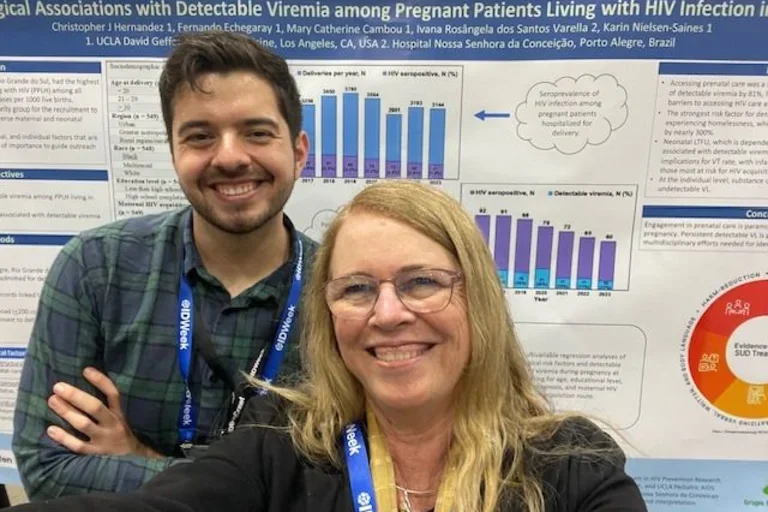
Photo: Dr. Nielsen and Christopher presenting their research